


The academic hangover
How your brain is affected by drinking
After a hard day or week, some of us look forward to unwinding with a drink or two. No big deal. We’re over the legal drinking age. We can still function and we’re mentally healthy, right?
Tread carefully. Be aware that those few drinks might be equivalent to a binge. Second, research is yielding troublesome findings about the effects of binge drinking on our brains—not just the night of, or the morning after, but well into the week, when we’re completing our mega-papers or prepping for finals.
studentvoice

Are you a binge drinker?
Most young adults do not drink heavily. Nevertheless, the highest rates of binge drinking in Canada are reported among adults aged 18–34, according to results from Statistics Canada’s Canadian Community Health Survey. In 2013, nearly 40 percent of males and 24 percent of females aged 20–34 reported heavy drinking at least once a month during the past year. (Of course, that leaves large majorities who don’t binge drink.)
What exactly is a binge?
Binge drinking is also called heavy drinking. It’s a pattern of drinking over a two-hour period that generally increases blood alcohol levels to 0.08 percent—the legal intoxication limit established by the Criminal Code of Canada. According to the Centre for Addiction and Mental Health, a binge for women typically means consuming four or more drinks on one occasion. For men, it usually means five or more drinks.
Not sure whether you binge? A self-diagnostic alcohol screening test.
How many student identify as binge drinkers?
Of nearly 600 Canadian students who responded to a recent Student Health 101 survey:
- 19 percent self-identified as binge drinkers.
- 7 percent picked the correct definition of binge drinking from a list of six options.
When asked how often they drank 4+ alcoholic drinks (women) or 5+ (men) in a sitting (the definition of binge drinking),
- 48 percent said never
- 37 percent said once a month or less frequently
- 12 percent said more frequently than once a month
The impact on the young adult brain
While some heavy drinkers may appear clinically healthy, their brain chemistry could be compromised, especially in young adults.
That’s because the frontal lobe rapidly matures well into our twenties. This developmental period is critical for “functions such as information processing, decision making, and impulse control, in part by improving communication between brain circuits,” says Dr. Yasmin Mashhoon, a neuroscientist at McLean Hospital in Belmont, Massachusetts, and Harvard Medical School.
The effect on our brains, grades, and safety
“Alcohol can interfere with the function of the hippocampus, the brain structure crucial for the encoding and consolidation of memory,” says Dr. Anna Patten, a postdoctoral fellow researching brain health at the University of Victoria’s Christie Laboratory in British Columbia.
The effects on your memory may linger for several days after drinking. “It could translate to the difference between an A and B or passing versus failing—or more importantly, making safe choices versus failing to inhibit poor choices, like driving while intoxicated,” says Dr. Marisa Silveri, also a neuroscientist at McLean Hospital, and associate professor of psychiatry at Harvard Medical School.
What do students say about the effect of alcohol on academic performance?
In a recent Student Health 101 survey, 63 percent of nearly 600 respondents said they thought getting drunk affected their academic performance over the next few days.
“I feel more lethargic and unproductive on days after I drink.”
—Fourth-year student at University of Winnipeg, Manitoba.
“Alcohol has taken a lot away from my [academic] performance. Not only because I drink and procrastinate at times, but because it’s more tempting than schoolwork.”
—Third-year student at Blue Quills First Nations College, St. Paul, Alberta.
“If I wake up hungover, with a fuzzy brain, [I’m] unable to focus on schoolwork.”
—Graduate student at University of Alberta, Edmonton.
Altered brain structure and function
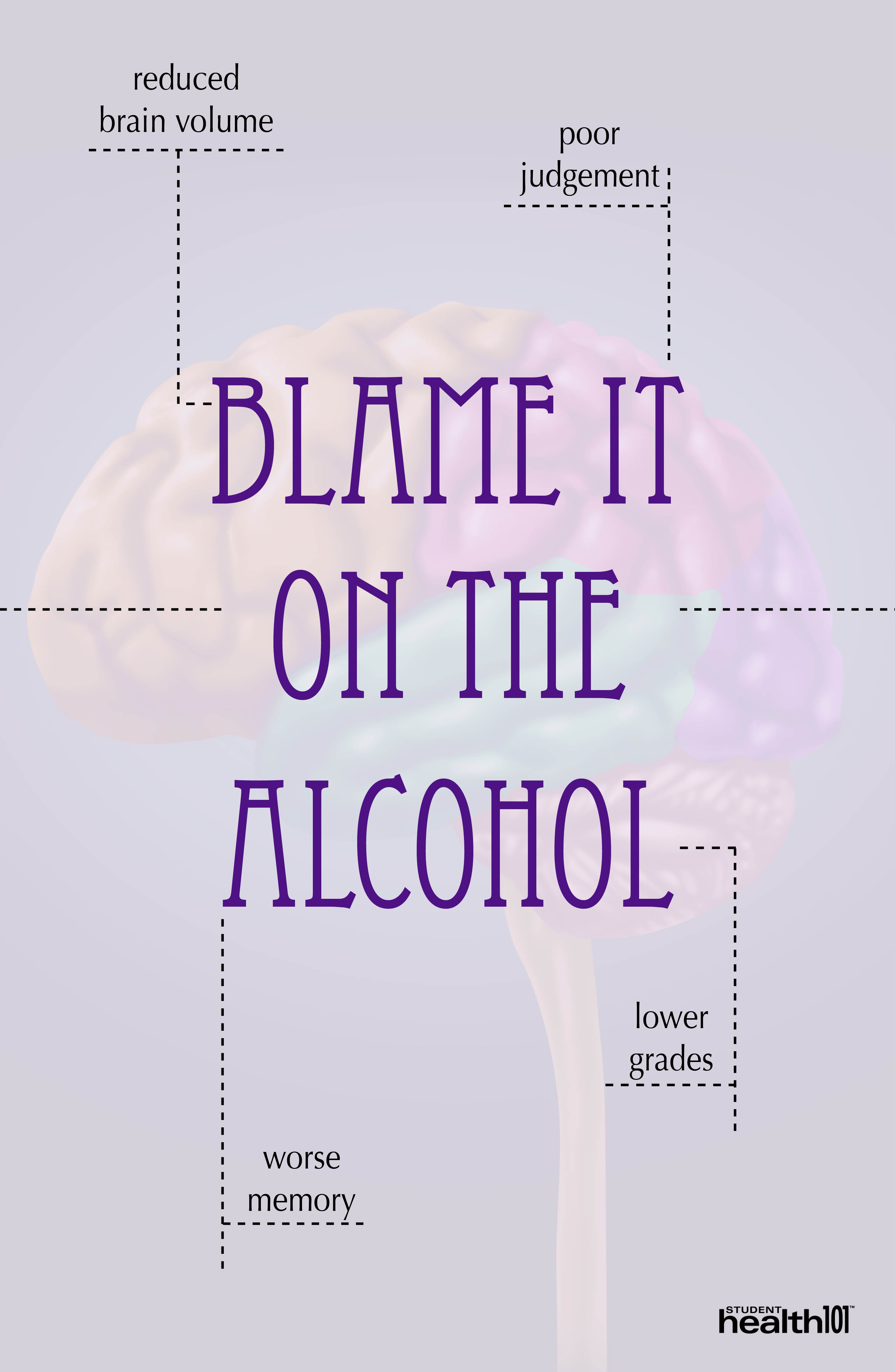
In a recent study, Dr. Silveri and her colleagues compared the brain structure and certain cognitive skills of college-aged light and heavy drinkers. The light drinkers reported an average of 1½ drinks per week over the previous three months. Heavy drinkers had consumed almost 12 drinks a week in the same period. Among the heavy drinkers, the cortical thickness, or outer brain volume, was significantly reduced.
This has implications for how we think and learn. Among the heavy drinkers, the researchers found impaired control, self-perception, and self-care; greater risk-taking; and worse academic or occupational consequences compared to the light drinkers.
They also found lower levels of GABA (gamma-aminobutyric acid), the most important inhibitory (calming) neurotransmitter, in the frontal lobe. Deficiencies in GABA are associated with a range of psychiatric disorders including depression, anxiety, and insomnia.
In addition, the heavy drinkers had lower levels of the metabolite NAA (N-acetylaspartate). Deficiencies in NAA are associated with impaired neuronal health (brain cell integrity).
In another study by Harvard-McLean researchers, light drinkers and heavy drinkers took verbal learning tests. Heavy drinkers recalled fewer words than the light drinkers, showing possible learning differences between the groups, and also performed relatively poorly on word recognition. Adults in their early twenties appear particularly vulnerable to the effects of heavy drinking on memory acquisition, according to earlier research.
Does heavy drinking cause these effects in the brain, or are people with these brain differences predisposed to heavy drinking? Animal studies have shown that binge drinking leads to comparable brain changes. Human studies to help unravel cause and effect are in the planning stages.
Which strategies do students favor for safe alcohol consumption?
- Stay with the same group of friends the entire time that you’re drinking
- Use a designated driver
- Eat before and/or with alcohol
- Keep track of how many drinks you’re consuming
- Stick with only one kind of alcohol
- Avoid drinking games
- Determine in advance not to exceed a set number of drinks
- Alternate non-alcoholic with alcoholic beverages
- Have a friend let you know when you’ve had enough
- Pace alcoholic drinks to no more than one per hour
From the American College Health Association—National College Health Assessment, Canadian reference group executive summary, spring 2013.
The risk to young women
Your mental image of a heavy drinker might be a male student chugging a beer through a funnel. But almost 30 percent more women drink heavily now than a decade ago, according to results from the 2012 Canadian Community Health Survey. The number of women aged 20–34 who binge drink increased by nearly 20 percent between 2009 and 2012.
Why are women at risk for heavy drinking?
- “Lower GABA levels during the luteal phase, or the latter phase of the menstrual cycle, make women more at risk for alcohol abuse,” says Dr. Silveri.
- Women have a higher blood alcohol content than men after drinking the same amount, even after accounting for body weight and food consumption. That’s because women have less body water than men to dilute the alcohol, and lower levels of alcohol dehydrogenase, an enzyme that breaks down alcohol.
- “New alcoholic beverages have been developed and marketed (e.g., flavoured malt beverages) that are known to appeal to underage girls,” says Dr. Dafna Kanny, Senior Scientist in the Alcohol Program at the Centers for Disease Control and Prevention in the US.
- The last few decades have seen an increasing social acceptance of alcohol consumption among women.
studentvoice

